Nanoanalytics
Membranes are extremely thin - only 4 to 5 nanometers thick - and very dynamic. Even the tiniest changes can have a big impact. For example, a small change in the chemical structure or an exchange of salts (electrolytes) can greatly affect the properties of the membrane.
It is therefore important to know exactly what a membrane is made of and to be able to measure changes in it. This is where nanoanalytics comes in. This requires a combination of different analytical methods, such as thin-layer chromatography, differential calorimetry or fluorescence spectroscopy. Our special method is small-angle X-ray and neutron scattering. Using this technique, we have developed our own models over the years to analyze membranes even better.
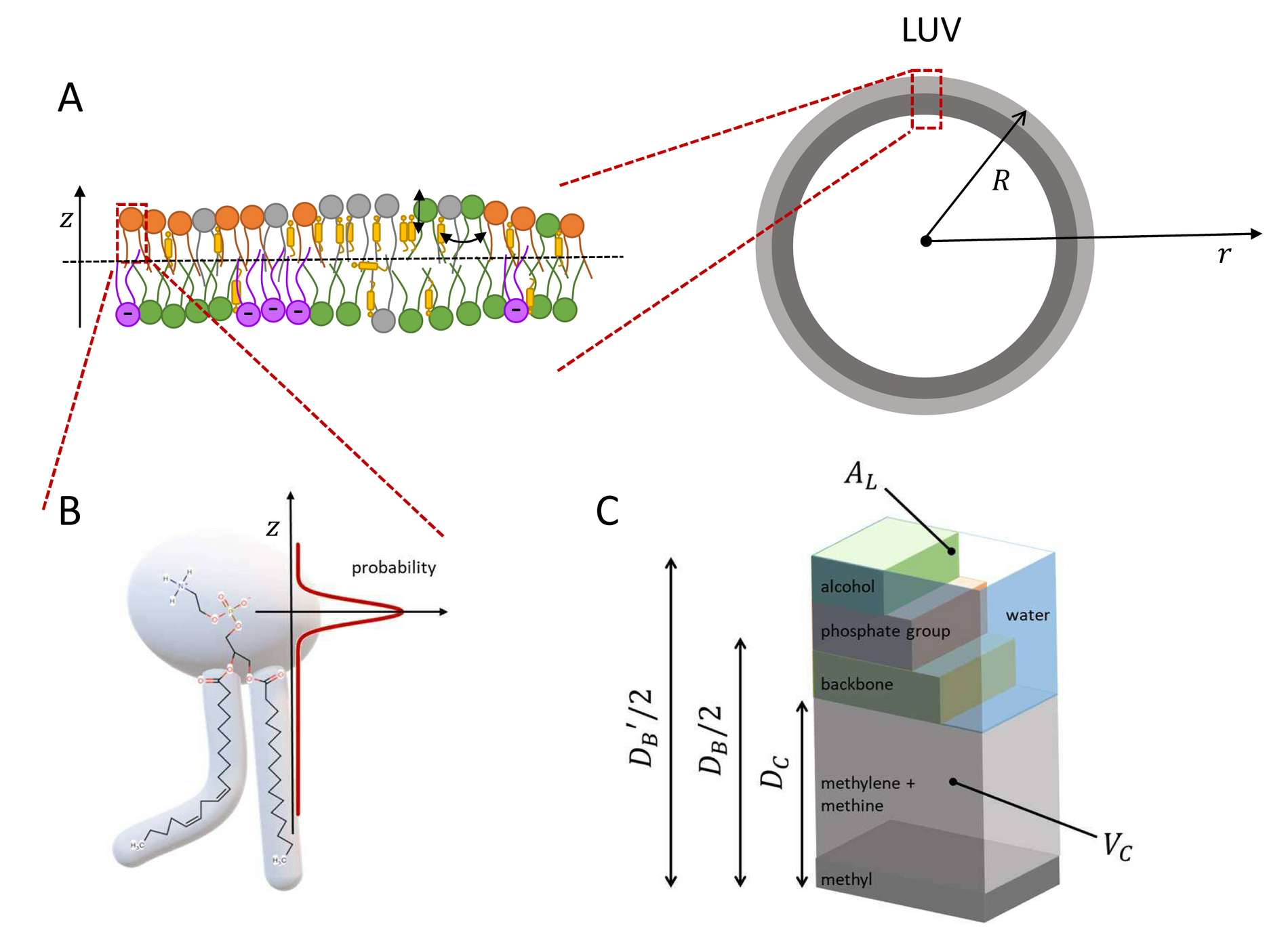
X-ray and small-angle neutron scattering experiments (SAXS, SANS) can visualise structures in the size range from around 1 to 100 nm - ideal for investigating membranes. By combining both methods, we can determine details such as the layer thickness or the space required by a lipid in the inner and outer half of the membrane separately. This is particularly exciting for asymmetric membranes. It also allows us to determine the molecular shape of lipids and observe how membrane-active peptides are positioned within the membrane.
Publications:
- Semeraro et al., in Methods in Enzymol, T. Baumgart, M. Deserno (edts), Academic Press, 700: 349 - 383 (2024) DOI: 10.1016/bs.mie.2024.02.017
- Semeraro et al, Soft Matter 17: 222 - 232 (2021) DOI: 10.1039/C9SM02352F
- Kaltenegger, et al, Biochim. Biophys. Acta 1863: 183709 (2021). DOI: 10.1016/j.bbamem.2021.183709
Examples
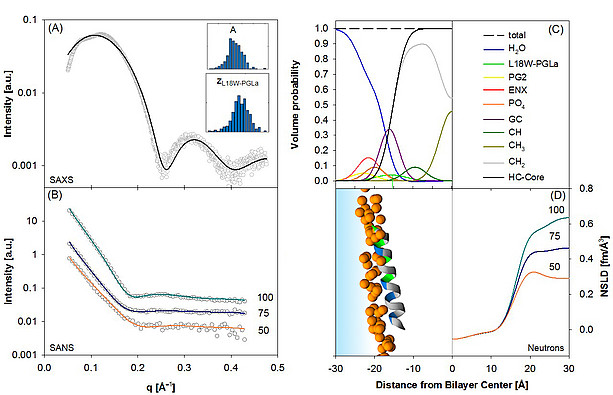
Design: G. Pabst, data from Pachler et al., Biophys J (2019) , License: (CC-BY 4.0 DEED)
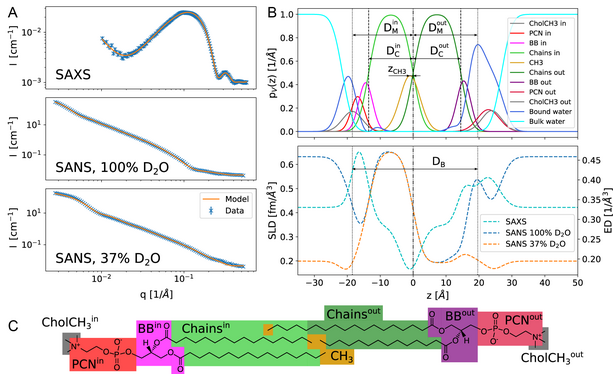
From: Frewein et al, J Membrane Biol (2022), License: (CC-BY 4.0 DEED).
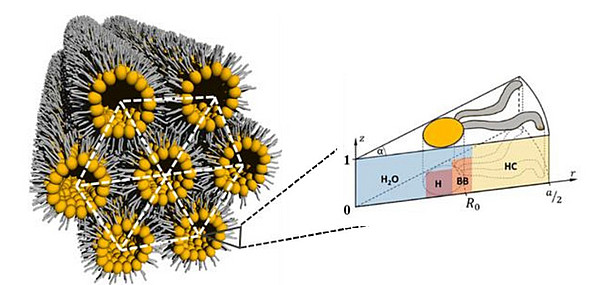
Design: G. Pabst, M. Frewein